A nose that is losing its black colour, or crusting along the edge of a nostril or an ear margin, is not a scrape and it rarely settles on its own. These are sites where immune-mediated skin conditions show up first, and the only thing that reliably separates them from the alternatives is a sample.
What owners actually notice first
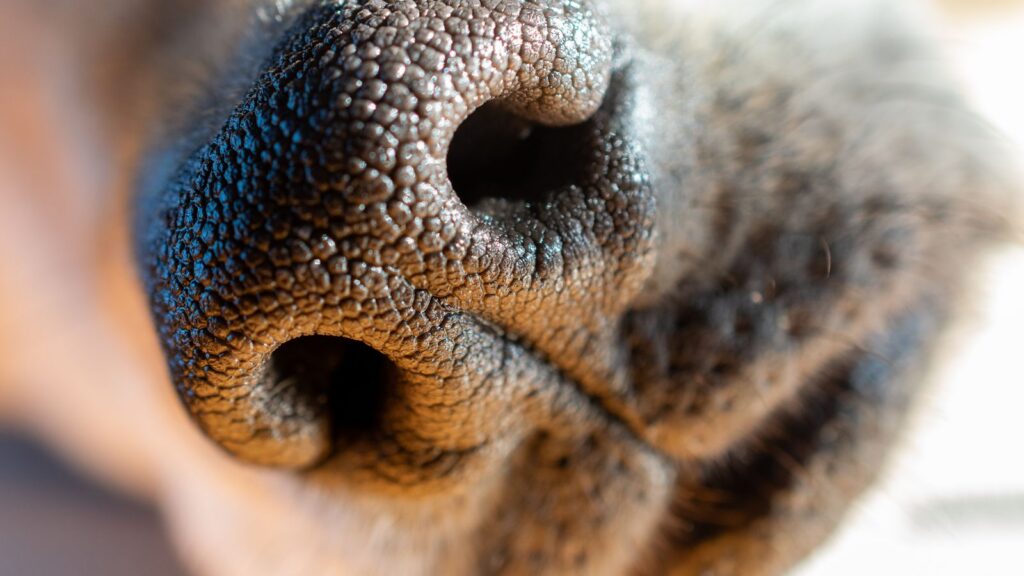
It is almost never dramatic. The usual version is a dog whose nose has gone from solid black to grey or pink in patches, often starting at the top where the leather meets the haired skin. The smooth, cobblestone texture flattens out and becomes shiny. Then it cracks, crusts, and sometimes bleeds a little when the dog rubs it.
The other common version is the ear. A thin line of crust builds along the very edge of the ear flap, the margin itself rather than the inside of the canal, and the hair there thins. Owners often find it while fussing a dog rather than looking for it.
Both of these get put down to a knock, a scrape from digging, or a bit of sunburn, and both get another couple of weeks of watching before anybody raises them.
What it is not
Three assumptions send these in late.
It is not a dry nose meaning an unwell dog. The old idea that a warm or dry nose indicates illness has no basis, and it cuts both ways: plenty of owners keep an eye on nose moisture while missing an actual change in the pigment and the surface.
It is not simply sun damage, although sun makes several of these conditions worse once the pigment has already gone. A pale nose burns more easily than a black one, so sun becomes part of the picture rather than the start of it.
And it is not a scrape, because a scrape heals. Anything on a nose that has not improved in two or three weeks, or that keeps returning to the same spot, has stopped being an injury and become a pattern.
Why the surface will not tell you
This is the part that matters, and it is the reason a dermatology referral exists.
Several quite different conditions produce an almost identical crusty, depigmenting nose. Some are immune-mediated, where the body is reacting against its own skin structures. Some are reactions to contact with something. Some are infections sitting on top of a surface that was already damaged. A few are unrelated to any of that. They look the same across a room, and in many cases they look the same up close too.
What they do not share is the plan that follows. So working through rounds of whatever is in the cupboard, or whatever helped a different dog, tends to produce a nose that looks slightly better for two weeks and then does not. Every round also makes the eventual answer harder to find, because the surface has been altered.
The step that settles it is a small sample of the skin itself, read under a microscope by someone who looks at skin all day. It is a short procedure, and it is the difference between a plan aimed at the actual mechanism and a plan aimed at a guess.
Our skin and ear conditions service is where that work-up happens, including the immune-mediated conditions that favour the nose and the ear margins. Where the ear flap and the canal are both involved, our ear care service covers that side properly rather than working on the margin alone. And because we see patients on referral, our referral process is where your own veterinarian sends the history over, which lets us prepare before the first consultation rather than starting from scratch on the day.
The sites worth checking tonight
These conditions are not random about where they appear. If you are looking, look here.
- The nose leather, particularly the junction where it meets haired skin, and whether the texture has gone smooth and shiny.
- The margins of both ears, running a thumb along the very edge rather than looking inside.
- The footpads, for cracking, thickening or a change from rough to hard and overgrown.
- Around the eyes and the lips, where crusting and pigment change often appear at the same time.
- The nail folds, at the point where nail meets skin.
Photograph whatever you find, in daylight, with something for scale beside it. Then photograph it again in two weeks. A dated pair of images is worth more than any description, because the useful question is not how it looks but what it has been doing.
What makes it urgent rather than a booked visit
- Bleeding that does not stop, or a nose that is bleeding from inside rather than from the surface.
- Breathing noisily through the nose, or working harder to move air.
- Crusting spreading quickly across the face over days rather than weeks.
- A dog who has become unwell alongside it, not eating, feverish or lethargic.
- Ulcers in the mouth appearing at the same time as the skin changes.
- Sudden swelling of the face or the muzzle.
Our hours and locations
We run two clinics and the days differ, so which one you come to usually depends on the day. Surrey, at 14823 108 Avenue, sees patients Monday, Tuesday, Thursday and Friday. Vancouver, at 15 East 3rd Avenue, sees patients Wednesday and Thursday. Both open at 8:00 am and close at 4:30 pm, and neither opens Saturday or Sunday.
A crusting nose is a booked referral appointment rather than an emergency, and it is worth arranging through your own veterinarian. Anything on the urgent list above, and in particular bleeding that will not stop or any difficulty breathing, should not wait for a referral slot: go to an open 24-hour emergency animal hospital, since we are closed evenings and both weekend days.
Common questions
My dog’s nose goes pale in winter and darkens again in summer.
That pattern is common and usually means nothing, and the texture stays normal throughout. The version worth seeing is pigment loss with a change in the surface: smooth, shiny, cracked or crusted.
Can you tell from a photograph?
A photograph tells us how concerning it looks and how quickly it should be seen, which is genuinely useful. It cannot tell us which condition it is, and anyone who says otherwise about a crusting nose is overreaching.
Should I put sunscreen on a pale nose?
Ask us first, because several products made for people are not suitable for a dog who will lick the area. Shade and avoiding the middle of the day do more than most owners expect.
Does a biopsy mean a general anaesthetic?
Not always. The approach depends on the site and the dog, and we will go through exactly what is involved before anything is arranged.
My dog is not itchy at all. Can it still be a skin condition?
Yes, and that is a useful clue rather than a reassuring one. Several of the conditions that favour the nose and ear margins cause very little itch, which is part of why they get overlooked.
Speak to the team at VetDERM Clinic
Photograph the nose and both ear margins today, in daylight, and note the date. If the texture has changed as well as the colour, ask your veterinarian about a referral rather than another round of something topical.
Published by the team at VetDERM Clinic.
This article is for general educational purposes only and is not a substitute for an in-person veterinary examination or advice about your individual pet. If you have an urgent concern about your pet, contact VetDERM Clinic or your nearest emergency veterinary hospital right away.
VetDERM Clinic
Vancouver: 15 East 3rd Avenue, Vancouver, BC V5T 1C5 (Wednesday and Thursday)
Surrey: 14823 108 Avenue, Surrey, BC V3R 1W2 (Monday, Tuesday, Thursday and Friday)
Phone: (604) 564-2214
Email: info@vetdermclinic.com
Hours: 8:00 am to 4:30 pm at both locations; closed Saturday and Sunday